The Mortgage Experts Guide to Prompt & Context Engineering
The way we use technology in financial services is evolving rapidly. Artificial Intelligence (AI) tools like ChatGPT are now part of the most mortgage expert’s toolkit, helping us save time, simplify complex topics, and communicate more effectively with clients. But just like in say mortgage advising, the quality of the outcome depends on the quality of the input. If you ask vague questions, you’ll get vague answers.
This is where prompt and context engineering comes in. Think of it as the art of asking better questions, giving clear instructions, and providing the right background so that AI can deliver exactly what you need. Done well, it can make your AI interactions 10X more effective, saving you time and helping you deliver even greater value to your clients.

Prompt Engineering vs. Context Engineering
It’s helpful to separate these two concepts:
- Prompt engineering is about how you ask. It’s the instructions, structure, and wording you use to guide the AI to produce the type of response you want, such as “write a professional email” or “summarise in bullet points.”
- Context engineering is about what you tell. It’s the background information and detail you provide, such as the client’s deposit, income, property type, or whether they’re a first-time buyer or a portfolio landlord.
Together, prompt engineering gives the AI direction, while context engineering gives it relevance. Without both, responses risk being too generic or off-target.
Why Prompt & Context Engineering Matters in The Mortgage Industry
- Clarity for clients: AI can turn complex jargon into simple, client-friendly explanations.
- Time savings: Draft reports, emails, and marketing posts in minutes instead of hours.
- Compliance awareness: You can tell AI to include disclaimers or highlight FCA rules.
- Personalisation: By giving the right context (client type, goals, circumstances), you get outputs tailored to your specific needs.
The 4-Step Framework for Writing Powerful Prompts
1.
Provide Context (Most Important)
The most impactful step. Add client details, objectives, and circumstances so the AI produces relevant answers.
Example: “The client is a first-time buyer earning £35,000 with a £20,000 deposit, looking to buy a £200,000 flat.”
2.
Define the Task
Be specific about what you want, such as, a summary, an email draft, a client-friendly explanation, or a comparison.
Example: “Explain the pros and cons of buying through a limited company vs in a personal name.”
3.
Set the Role
Tell the AI who to act as. This frames the response in the right perspective.
Example: “Act as a UK mortgage adviser with CeMAP qualifications.”
4.
Set the Tone & Format
Tell the AI how to present the information.
Example: “Write in a friendly, professional tone, under 300 words, using bullet points. End with a call-to-action to speak with me.”
Example Prompts: Good vs. Bad
Bad Prompt:
“Explain buy-to-let mortgages.”
Why it doesn’t work: Too vague, no context, no task clarity, no role, no style.
Better Prompt:
“My client is a first-time landlord with a £100,000 deposit who is considering buying a £400,000 property. Please explain the pros and cons of taking out a buy-to-let mortgage for them. Act as an experienced UK mortgage adviser, and write the response in clear, friendly language under 300 words, using bullet points. End with a call-to-action to contact me for tailored advice.”
Why it works: You’ve set the role, provided client context, defined the task, and guided the style.
Mortgage-Specific Prompt Examples
“My client is considering buying a buy-to-let property worth £250,000. They’re unsure whether to purchase it in their personal name or through a limited company. Summarise the pros and cons of each option. Write as a UK mortgage adviser, keep it under 250 words, and use a two-column comparison table.”
“I have a client whose 2-year fixed-rate mortgage deal is ending in 6 months. Write a professional but friendly email explaining why it’s important to review their options early. Act as their mortgage adviser, use a supportive tone, and end with a call-to-action inviting them to book a review meeting.”
“Many landlords I speak to are unsure about what to expect when remortgaging in 2025. Write a LinkedIn post (around 200 words) that explains the top 3 things landlords should know. Write as a UK mortgage adviser, keep it concise and engaging, use bullet points, and finish with a clear tip to get in touch for personalised advice.”
The Power of Iteration
One of the biggest advantages of working with AI is that you don’t have to get the perfect answer the first time. Think of it like drafting a client suitability report in that the first version is rarely the final one. Iteration means refining your prompt step by step. If the answer feels too complex, ask the AI to simplify it, or if it’s too short, ask it to be expanded.
Each follow-up helps the AI align closer to what you really need. By treating AI like a junior team member you’re coaching, you’ll find that every iteration sharpens the result until it’s exactly right for your client or business use case.
Watch Out for Hallucinations
AI can be incredibly powerful, but it’s not perfect. Sometimes it produces information that sounds confident but isn’t factually correct. This is known as a “hallucination.” In the mortgage world, that could mean quoting the wrong income multiple, referencing an outdated stamp duty rule, or suggesting a lender criteria that doesn’t actually exist. This is why your role as the adviser is critical. You must always fact-check the AI’s answers against trusted sources, lender criteria systems, or your own expertise. Think of AI as a helpful assistant that drafts ideas and saves you time, but one that still needs your professional oversight before sharing anything with a client.
Top Tips for 10X Better Prompts
- Be specific: The more detail you provide, the more accurate the response.
- Use roles: Tell the AI to act as a mortgage adviser, compliance officer, or marketing expert. You can also ask it to ‘model’ a known expert, such as Richard Branson!
- Add client context: Include income, deposit, property type, experience, and goals.
- Control style: State if you want a formal letter, friendly email, LinkedIn post, or bullet-point guide.
- Iterate & refine: Don’t settle for the first attempt — ask the AI to simplify, expand, or add examples.
- Include compliance reminders: e.g. “Add a disclaimer reminding the client this is general guidance and not personal advice.”
- Fact check: Make sure you are checking the accuracy of the output before using it.
Final Thoughts
Prompt and context engineering is about teaching the AI to think like you do. The more detail you provide, the more value you’ll get back. Whether you’re drafting client emails, creating marketing content, or preparing advice documents, by setting the role, giving context, defining the task, and guiding the tone, you’ll get far more relevant, accurate, and professional outputs from AI.

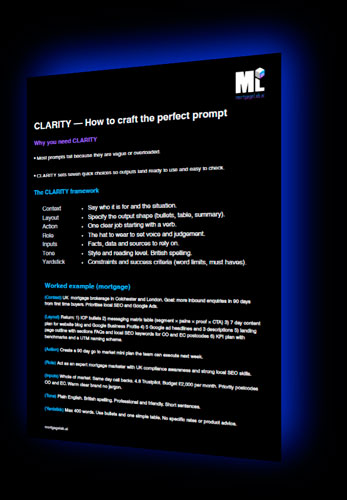
Think CLARITY!
Grab the one-page CLARITY cheat sheet as a PDF and keep it next to your keyboard. It breaks great AI prompts down into seven quick choices, with a worked UK mortgage example you can copy, adapt and reuse for your own marketing and client comms. Download it, print it, or share it with your team so every prompt you write is clear, compliant and ready to use first time.